

The 100-Meter Mirage: Decarbonizing Data Center Architecture Through Layer 1 Simplification
The modern data center is currently navigating a period of unprecedented densification. Driven by the massive compute requirements of AI and machine learning, facility operators are under constant pressure to optimize every square foot of revenue-generating "white space" while simultaneously driving down Power Usage Effectiveness (PUE). In this environment, the physical layer - the cabling infrastructure - is often overlooked as a static utility. Yet, the foundational constraints of Ethernet topology, specifically the decades-old IEEE 802.3 100-meter limit, are increasingly at odds with the scale and economic goals of hyperscale and colocation facilities.
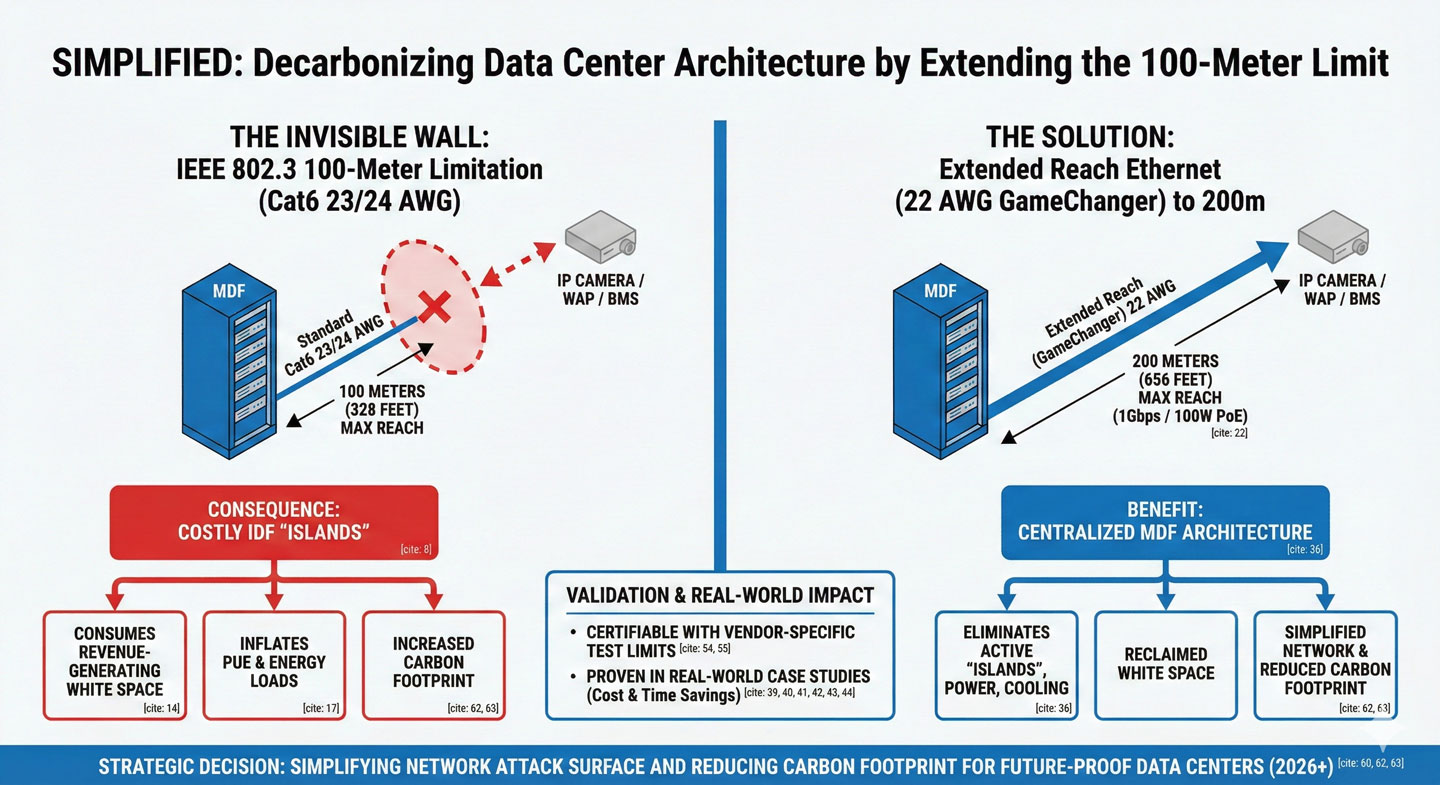
This 100-meter (328-foot) limitation for twisted-pair copper cabling has long acted as an "Invisible Wall" for network architects. To service devices like IP security cameras, wireless access points (WAPs), or Building Management System (BMS) sensors located beyond this radius, engineers have been forced into costly compromises. The default solution has been the deployment of Intermediate Distribution Frames (IDFs), or network closets, which introduce budget-busting "islands" of hardware, power, cooling, and the additional labor required to install and maintain it.
The Hidden Physics of the IDF "Island"
The true cost of an IDF is rarely just the rack and the switch. It is a consumer of critical facility resources. Building an IDF requires architectural design, electrical permits, and dedicated cooling. A single IDF installation is estimated to cost between $18,000 and $55,000. For a data center operator, this creates a cascade of consequences:
Real Estate Opportunity Cost: Each IDF consumes "white space" that could house revenue-generating server racks. In a colocation model, where each rack position can generate significant monthly revenue, the opportunity cost of an IDF footprint is immense.
Active Hardware Lifecycle: A switch in an IDF has a typical lifecycle of 5-7 years and requires annual battery testing for local UPS backup.
Thermal and Energy Loads: Every watt consumed by an IDF switch requires roughly another watt to cool it, directly inflating the facility’s PUE and working against sustainability goals.
Furthermore, every added component - whether it is a repeater, media converter, or a remote switch - introduces a new potential point of failure. In mission-critical environments, simplicity is the primary driver of reliability.
Material Science vs. The 100-Meter Barrier
Overcoming this distance barrier requires a shift from proprietary electronics to advanced material science. Innovative extended reach Ethernet cable achieves this by re-engineering the physical properties of the cable to transmit 1Gbps (and up to 2.5Gbps) and 100W Power over Ethernet (PoE) at distances up to 200 meters (656 feet).
The primary mechanism for this extended reach is the use of 22 AWG solid bare copper conductors. Standard Category 6 cables typically use 23 AWG. The cross-sectional area of a 22 AWG conductor is roughly 30% larger than a 23 AWG wire, which directly correlates to a reduction in DC resistance.
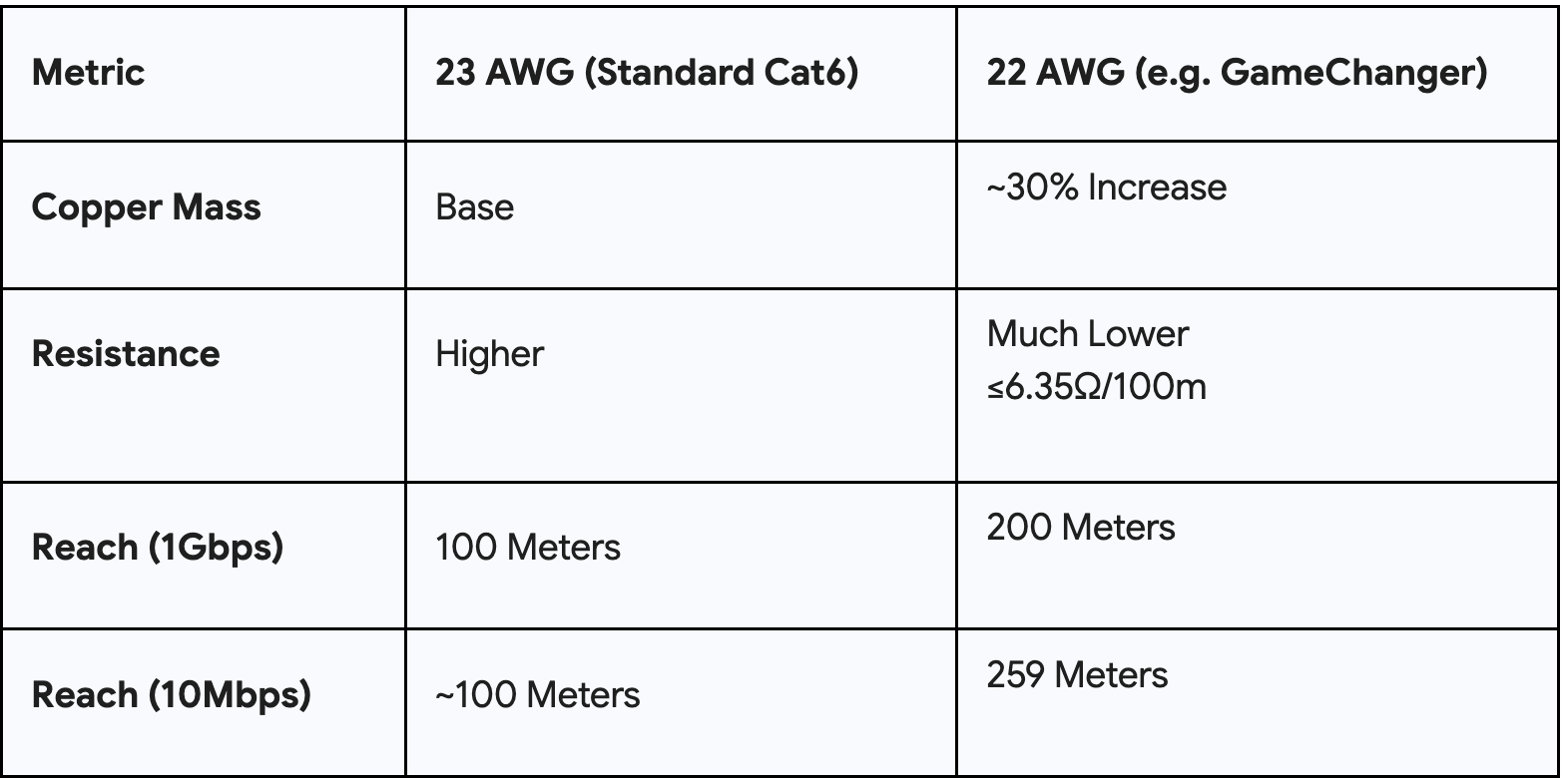
While increasing the gauge size helps drive the signal farther and is very helpful for PoE, it doesn’t guarantee that the signal is problem-free at the end of the transmission. Electrical characteristics like Delay Skew (which is the difference in transmission time between the fastest and slowest pairs) still need to be addressed with design changes. Accordingly we’ve optimized the twisting geometries to ensure the data is all delivered within the timing expectations of the protocol.
Validating the "Geometric Multiplier"
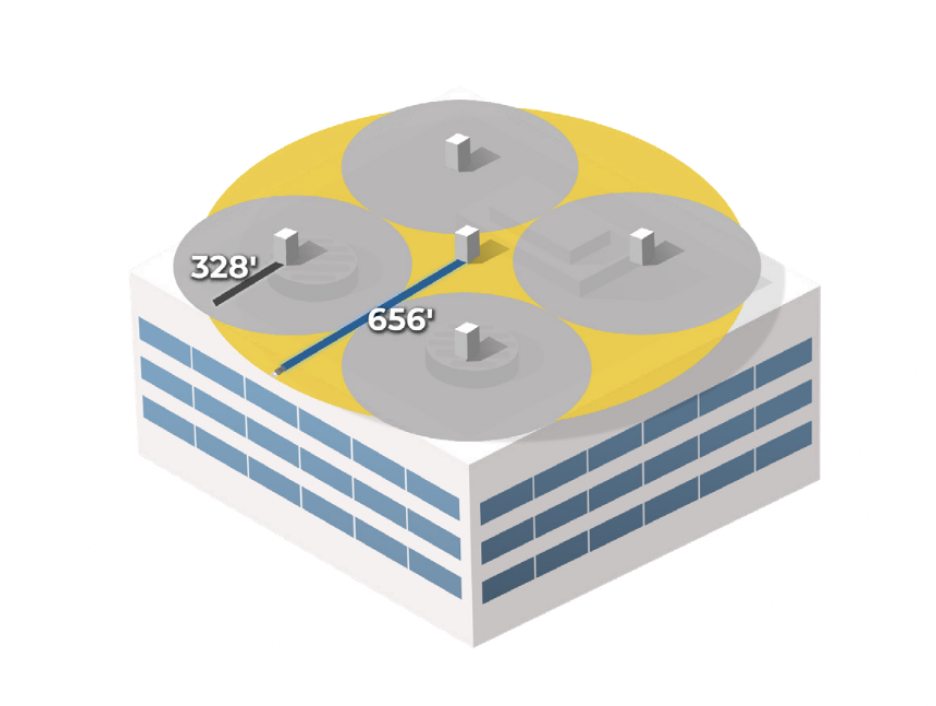
The most transformative aspect of doubling cable reach is the geometric advantage. According to A=π(2r)², doubling the radius of a circle quadruples its area.
Standard 100m Reach: Covers approximately 31,400 sq ft.
Extended 200m Reach: Covers approximately 125,600 sq ft.
For a large-scale colocation or hyperscale facility, this math implies a potential reduction of 75% in the number of required telecommunications rooms. In multi-story facilities, this improvement can be even more dramatic. By centralizing the network to the Main Distribution Frame (MDF), operators can eliminate the active electronics, power feeds, and cooling requirements associated with distributed IDFs.
Case Studies in Infrastructure Optimization
The financial impact of this architectural shift is evidenced in several real-world deployments:
Large Hyperscale operator: Large data halls create long distances between the operational servers and the devices used to monitor and control them. Historically this has meant including hardware that will extend or transcode Ethernet signals over a different protocol to work across distances greater than 100m. One Hyperscaler has adopted GameChanger as their basis of design to allow for server control without additional hardware to install, maintain, power or cool. A simplified design that has been estimated to provide upfront and ongoing savings of greater than a million dollars globally.
Large Colocation Facility: In a deployment of 120 cabling drops for extended-distance cameras, the use of GameChanger saved $2,006.60 per run compared to traditional extenders. This totaled over $240,000 in day-one material savings alone, prior to calculating the avoided costs of power and long-term maintenance.
Security Infrastructure: An independent study of a 160 IP camera installation showed that GameChanger materials cost roughly $22,305, while a hybrid fiber/copper solution with media converters exceeded $126,000.
Expanding the Use Case: From Security to Safety
While surveillance and WAPs are the primary high-volume applications, the rise of IP-based DCIM, Sensors, and liquid cooling is creating new demands for extended copper runs.
Modern high-density AI clusters (50kW-100kW per rack) are increasingly moving toward liquid cooling, which introduces the need for IP-based leak detection. These safety systems must be infallible. A fiber connection with a media converter introduces a power-dependent active component into the safety chain. If the converter's power supply fails, the leak detection goes offline. A passive copper connection via extended reach Ethernet cable is inherently more reliable for these safety-critical systems, as the power is sourced centrally from a UPS-backed MDF.
Additionally, the availability of specialized SKUs for "Class 1 Division 1" (C1D1) hazardous locations allows facilities to run Ethernet directly into generator yards or fuel storage areas without the need for rigid conduit seals at every boundary, significantly reducing installation labor.
Operational Realities and Field Validation
A common skepticism among network engineers involves the certifiability of non-standard cabling. However, cables such as GameChanger can be certified using industry-standard handheld testers like the Fluke Networks DSX series. The mechanism relies on "vendor-specific test limits" embedded in the tester software, which account for the 22 AWG physics.
No network electronics changes need to be considered up to 200 meters. For operational stability on extreme runs between 200 and 259 meters, a vital detail is simply hard-setting switch ports to 10Mbps. This prevents the auto-negotiation pulses from timing out due to propagation delay, which can cause link flapping. This prescriptive guidance transforms the technology from a "workaround" into a managed architectural standard.
Future-Proofing for 2026 and Beyond
As data centers evolve into "instrumented factories" with a high density of thermal and pressure sensors, the legacy 100-meter limit will continue to drive burdensome complexity. Choosing to design a facility around a 200-meter reach is not just a tactical fix for a distant camera; it is a strategic decision to simplify the network's attack surface and reduce its carbon footprint.
Passive copper infrastructure has a functional lifespan of 20+ years, outlasting three or more generations of active hardware refresh cycles. By eliminating the active "islands" of the 20th-century network, forward-thinking facility owners can reclaim their white space and focus on their core mission: delivering the power and cooling required for the next generation of computers.

GCG Data Center Solutions
Jeff Young, Director of Strategic Accounts, GCG Data Center Solutions
Jeff Young is Director of Strategic Accounts at GCG Data Center Solutions, where he works with hyperscale operators, colocation providers, and enterprise clients on power distribution infrastructure for high-density deployments. With over 25 years in data center infrastructure, Jeff specializes in the electrical and thermal challenges of AI/ML workloads.