

The AI Infrastructure Awakening
The 100kW Rack Reality: Why Your 'Last 10 Feet' of Cabling Deserves Engineering Scrutiny
Disclosure: This analysis draws on field observations from data center deployments where GCG provides power distribution solutions. The engineering principles discussed apply industry wide.
The numbers are no longer theoretical. With the deployment of next-generation hardware like NVIDIA's Rubin architecture, we aren't just creeping up on density limits - we are pushing through them. The days of the comfortable 5kW to 10kW rack are over. We are now engineering for 40kW, 60kW, and in liquid-cooled deployments, surpassing 100kW per rack.
For the facility operator, you're managing multiple constraints simultaneously: a documented shortage of skilled data center technicians, grid capacity limits in key markets, and supply chain delays for electrical infrastructure components. In this environment, most attention focuses on primary systems - chillers, UPS arrays, switchgear. But one of the most overlooked failure points isn't the utility feed. It's the last ten feet of power distribution.
The "whip" - that cable assembly connecting the track busway to the rack PDU - has transitioned from a commodity accessory to a critical engineered component. If you're still spec'ing 208V/30A drops for AI workloads, the mismatch becomes apparent the moment the first GPU cluster powers on.
The Complication: When Physics Hits the Floor
Legacy infrastructure was forgiving. If a technician left a few feet of slack in a power cord under a raised floor serving 5kW racks, the impact on static pressure would be negligible. But the rules change when you concentrate power distribution within the same physical footprint.
The Airflow Choke Point
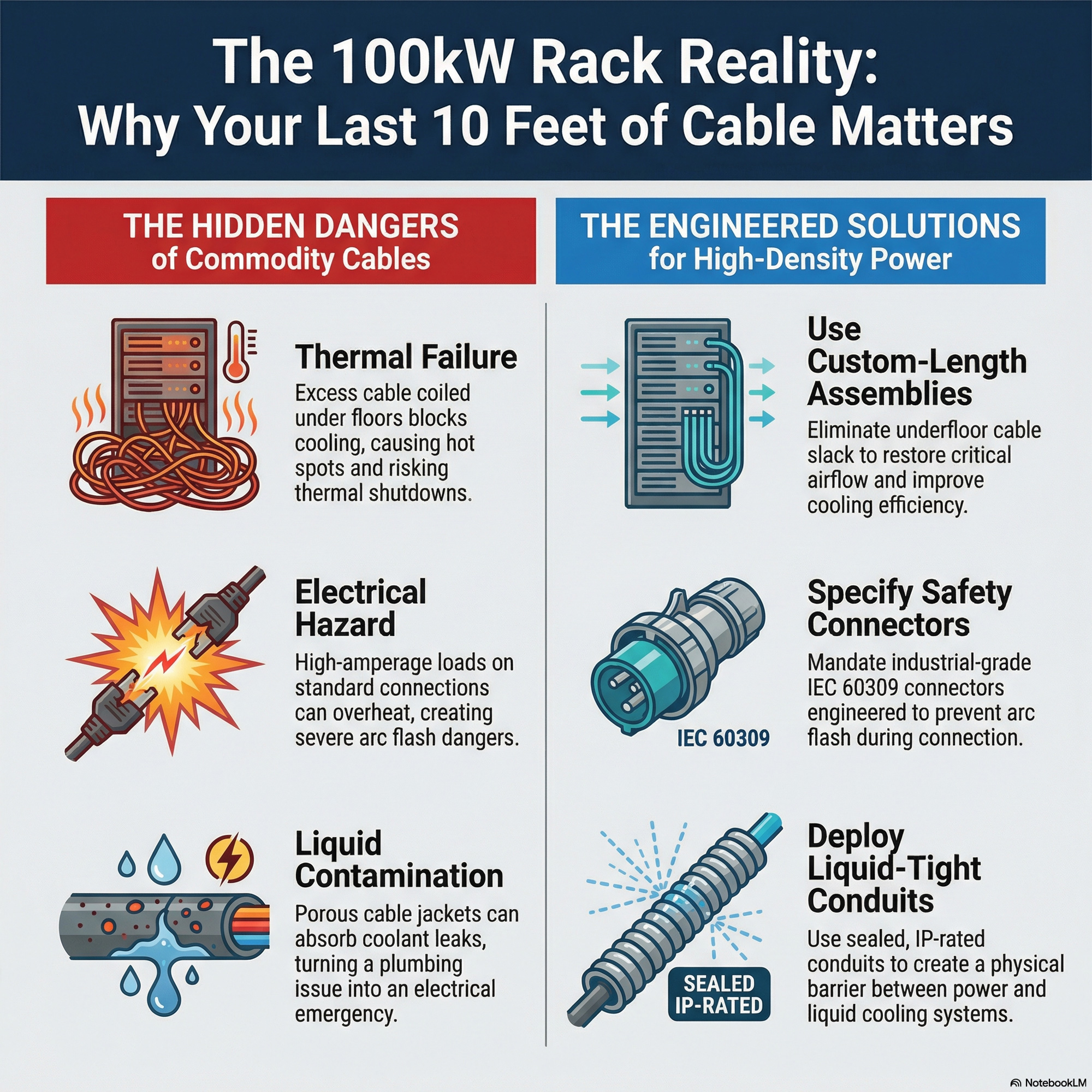
In high-density air-cooled or hybrid environments, airflow is currency. To cool a 50kW+ rack, your CRAC (Computer Room Air Conditioning) units must maintain precise static pressure differentials. The enemy here is underfloor obstruction. Standard, off-the-shelf power whips come in fixed lengths - typically 15, 20, or 30 feet. When you install a 30-foot whip for a 20-foot run, that extra ten feet must go somewhere. It usually ends up coiled under the floor.
Multiply that by hundreds of circuits, and you create an air dam. These obstructions block cold air delivery, creating hot spots that force cooling systems to work harder, driving up PUE (Power Usage Effectiveness) and risking thermal shutdowns. You can deploy the most efficient chillers on the market, but if air cannot reach the intake because of cabling obstructions, you've compromised your thermal design.
The Voltage Drop Reality
Then there is the electrical consideration. Moving from standard enterprise workloads to AI training models often necessitates a voltage shift - frequently from 208V to 415V three-phase power - to minimize amperage draw and reduce conductor mass requirements. Standard cable assemblies running at sustained peak loads face resistance issues that manifest as voltage drop. A connection failure at 100kW doesn't just cause a server to reboot; according to NFPA 70E standards, high-resistance connections under load generate sufficient heat to degrade insulation, creating arc flash hazards.
What We're Seeing in the Field
The consequences of underestimating power distribution infrastructure are already documented. In 2023, a Texas data center experienced a significant outage when cooling systems failed to maintain temperature setpoints during peak load testing. Post-incident analysis revealed that underfloor cable congestion had reduced static pressure by approximately 20%, forcing mechanical systems to operate beyond design capacity. The facility was eventually forced to implement overhead busway and remove raised floor obstructions - a retrofit that took the affected halls offline for weeks.
This isn't isolated. We're observing a pattern: RFPs for GPU-dense facilities still specify legacy power distribution approaches, then encounter thermal management problems during commissioning when the actual density materializes on the floor.
The Technical Requirements: Engineering Safety at 60+ Amps
The shift to higher amperage circuits - 60A and 100A at the rack level - demands rethinking connector safety protocols. In the past, a technician might have casually disconnected a server rack. Attempt that with a live high-amperage AI cluster, and you're creating an arc flash event.
This is where the specification of IEC 60309 Pin & Sleeve devices becomes standard practice for safety-critical applications. Unlike standard NEMA locking plugs, these devices are engineered with a "make-first/break-last" safety ground sequence. The ground connection establishes before any power pins connect and breaks only after power pins have disconnected.
Furthermore, the design features shrouded pins - a physical barrier ensuring that personnel cannot accidentally contact live conductors during connection or disconnection. In environments where the "Gray Space" (electrical rooms) and "White Space" are merging due to density requirements, protecting human operators is non-negotiable.
The Liquid Cooling Factor
We also cannot ignore the integration of liquid cooling systems. According to Uptime Institute's 2024 Global Data Center Survey, liquid cooling adoption increased from 5% to 15% of respondents between 2022 and 2024, with projections suggesting continued acceleration. This brings water and dielectric fluids into proximity with high-voltage power distribution.
Standard SOOW cords are porous; over time, they can absorb oils and fluids. If a coolant leak occurs, a saturated cable jacket can become a conductive path, turning a plumbing issue into an electrical emergency. The engineering requirement becomes clear: sealed, IP-rated barriers between power distribution and cooling systems.
The Solution Framework: Engineered Precision Over Commodity Approaches
The solution isn't simply to provision more power capacity; it's to deliver power with higher precision and safety margins. This requires treating the last ten feet of power distribution as an engineered system component rather than an interchangeable commodity.
Customization as a Thermal Strategy
The most effective approach to solving underfloor airflow obstruction is to eliminate excess conductor length. Custom-length cable assemblies - cut to the exact measurement required for specific tile locations - remove the service loops that compromise underfloor airflow. This isn't purely aesthetic; it's operational. By clearing underfloor obstructions, you recover static pressure capacity, allowing cooling infrastructure to operate within design parameters. This directly contributes to lowering facility PUE.
Visual Management and Redundancy Protection
In high-stress outage scenarios, human error rates increase. A technician attempting to balance loads might accidentally disconnect the wrong feed. One approach gaining adoption is operational color-coding through Liquid-Tight Flexible Metal Conduit (LFMC) available in multiple colors. This allows operators to instantly distinguish between "A-Feed" (primary), "B-Feed" (redundant), and "C-Feed" (maintenance) power sources without tracing cables back to the breaker panel.
The Liquid-Tight Defense
To address liquid cooling risks, sealed cable assemblies utilizing Liquid-Tight Flexible Metal Conduit (LFMC) provide IP-rated barriers. Unlike porous rubber cords, this conduit construction creates a sealed barrier. Paired with watertight IEC 60309 connectors rated for the application, power distribution systems can coexist safely with Direct-to-Chip cooling deployments.
Factory Testing as Risk Mitigation
In compressed construction schedules, on-site testing is often abbreviated or deferred. Pre-tested cable assemblies - validated for dielectric strength per UL standards, ground continuity below specified resistance thresholds, insulation resistance, and critically, phase rotation - eliminate a common failure mode. A phase error at the PDU level can damage three-phase motors in in-row cooling units or trigger UPS faults. Factory testing to documented standards addresses this risk before equipment reaches the site.
Implementation Approaches
The industry is moving from commodity cabling to engineered power delivery assemblies. Companies like GCG have built entire product lines around this requirement, offering custom-length whips with factory testing, LFMC construction, and IEC 60309 terminations. Other manufacturers are developing similar approaches as the market recognizes that high-density infrastructure requires component-level precision.
The key is specifying requirements rather than accepting standard catalog items: exact lengths to minimize underfloor obstruction, appropriate IP ratings for cooling integration, documented testing protocols, and connector types that prioritize safety in high-amperage applications.
The Retrofit Reality vs. Hyperscale Approaches
Large cloud providers have increasingly moved to overhead busway distribution and rear-door heat exchangers, effectively sidestepping raised floor limitations. But for colocation providers, enterprise AI labs, and facilities retrofitting existing infrastructure, removing raised floors isn't economically viable. The engineering question becomes: how do you achieve hyperscale reliability in a retrofit environment?
The answer lies in optimizing every component in the power path - including those last ten feet that most teams treat as an afterthought.
Future Outlook: Building for the 2027 Grid
As we move toward 2027, the density curve shows no indication of flattening. We are entering an era where the data center resembles an industrial power facility more than a traditional computer room. The distinction between IT cabling and industrial power distribution continues to blur.
The engineering challenges of 100kW racks require rethinking every component in the power path - including the last ten feet most teams overlook. Your infrastructure decisions today determine operational resilience tomorrow. By treating power distribution as an engineered system rather than a commodity purchase, you gain the ability to deploy faster, cool more efficiently, and most importantly, maintain safe operating conditions in an increasingly high-voltage environment.
The 100kW rack has arrived. The infrastructure supporting it needs to evolve accordingly.
For questions or site-specific assessments, contact GCG Data Center Solutions at datacenters@gogcg.com
References and Resources
NFPA 70E: Standard for Electrical Safety in the Workplace (2024 Edition) - Arc flash hazard analysis and high-resistance connection thermal effects
IEC 60309: International standard for industrial plugs, socket-outlets and couplers for industrial purposes - Pin and sleeve connector specifications
Uptime Institute Global Data Center Survey 2024: Liquid cooling adoption trends and projections. Available at: https://uptimeinstitute.com/
ASHRAE Technical Committee 9.9: Mission Critical Facilities, Data Centers, Technology Spaces, and Electronic Equipment - Thermal guidelines and airflow management best practices. Resources at: https://tc99.ashraetcs.org/
Data Center Dynamics: "Texas Data Center Faces Extended Outage After Cooling System Failure" (2023) - Case study on underfloor obstruction impacts
UL 1995: Standard for Heating and Cooling Equipment - Testing protocols for electrical connections and assemblies
IEEE 1100: Recommended Practice for Powering and Grounding Electronic Equipment (Emerald Book) - Power quality and distribution design
Uptime Institute Tier Standard: Topology requirements for different tier levels, including power distribution redundancy. Available at: https://uptimeinstitute.com/tier-certification
NVIDIA GPU Architecture Documentation: Power and cooling requirements for H100, H200, and upcoming Rubin architecture. Available at: https://www.nvidia.com/en-us/data-center/
7x24 Exchange: Industry association providing education and best practices for mission-critical infrastructure professionals. Resources at: https://www.7x24exchange.org/

GCG Data Center Solutions
Jeff Young, Director of Strategic Accounts, GCG Data Center Solutions
Jeff Young is Director of Strategic Accounts at GCG Data Center Solutions, where he works with hyperscale operators, colocation providers, and enterprise clients on power distribution infrastructure for high-density deployments. With over 25 years in data center infrastructure, Jeff specializes in the electrical and thermal challenges of AI/ML workloads.